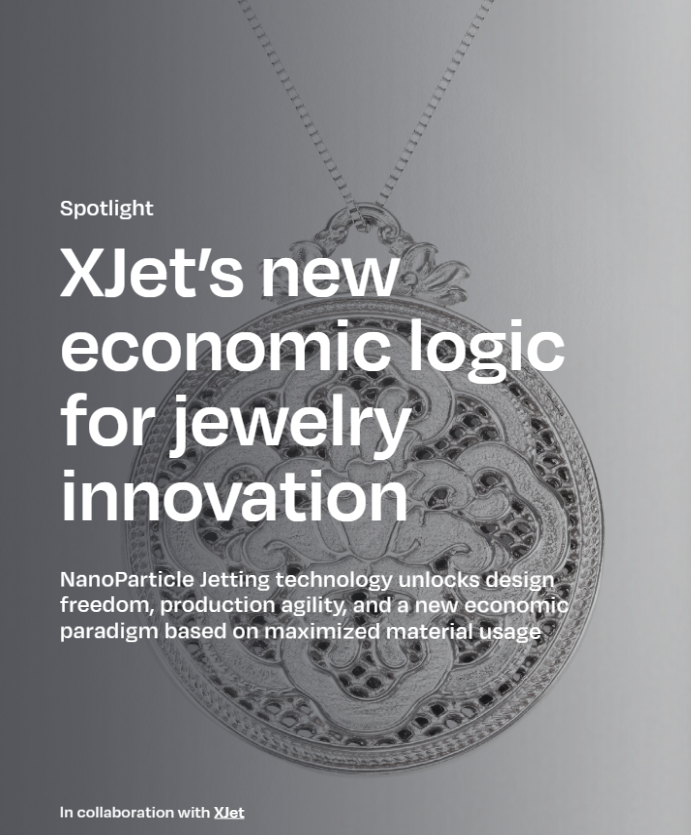
For many years now, jewelry designers all over the globe have embraced additive manufacturing, as it has enabled them to both simplify and enhance jewelry design and prototyping processes. That is, by 3D printing jewelry models using castable resin or wax, jewelry makers have not only arrived at final designs faster, they have also benefited from greater design freedom and customizaiton.
Still, this indirect production method involves many steps and can be limited in terms of possible geometries (such as prohibiting the integration of hollow features or lattices). That’s where direct material additive manufacturing technologies, like XJet’s NanoParticle Jetting (NPJ), have been gaining ground in the luxury consumer markets.
More News
Science Park, 4 Oppenheimer Street,
Rehovot 7670104, Israel
We use cookies to ensure that we give you the best experience on our website. If you continue to use this site we will assume that you are happy with it.